

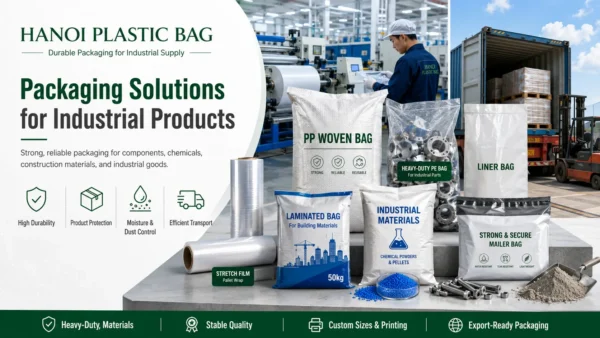
Packaging Solutions for Industrial Products
Industrial products require packaging that does more than simply cover or contain goods. In many cases, packaging must protect heavy, sharp, bulky, dusty, moisture-sensitive, or chemically sensitive products during storage, handling, transportation, and export.
For businesses in manufacturing, construction, chemicals, machinery, hardware, agriculture, and industrial supply, choosing the right packaging solution is essential. Poor packaging can lead to product damage, leakage, contamination, customer complaints, shipment delays, and unnecessary replacement costs.
That is why industrial packaging must be designed with strength, protection, safety, and supply chain efficiency in mind.
Why Industrial Products Need Stronger Packaging
Unlike consumer goods, industrial products are often exposed to tougher handling conditions. They may be stacked in warehouses, loaded into containers, moved by forklifts, transported over long distances, or stored in challenging environments.
Common risks include tearing, puncture, moisture damage, dust contamination, leakage, deformation, and product loss during transportation.
For global buyers, distributors, and manufacturers, packaging failure can affect not only the product itself but also production schedules, customer trust, and total logistics cost.
A reliable industrial packaging solution should help protect the product, maintain product quality, improve handling efficiency, and support safe delivery to the final destination.
Packaging for Industrial Components and Spare Parts
Industrial components, machinery parts, metal fittings, plastic parts, electrical parts, and hardware items often require packaging that protects against scratches, dust, moisture, and impact during handling.
For small and medium-sized components, PE bags, LDPE bags, HDPE bags, zipper bags, and customized poly bags can be suitable options. These bags can be produced in different thicknesses, sizes, colors, and packing formats depending on the product’s weight and shape.
For sharper or heavier components, stronger material structures may be required to improve puncture resistance and tear strength. In some cases, inner bags can be combined with cartons, outer sacks, or pallet wrapping to provide additional protection.
Common solutions include:
Heavy-duty PE bags
Customized poly bags
Zipper or resealable bags
Anti-dust inner bags
Printed bags for part identification
Carton liners
Pallet stretch film
These solutions help manufacturers organize components more clearly, reduce contamination, and support more efficient storage and distribution.
Packaging for Chemical Products
Chemical products require careful packaging selection because the packaging material must be compatible with the product inside. A wrong choice may cause leakage, weakening of the packaging, contamination, or safety risks.
For non-hazardous chemical powders, granules, pellets, additives, or industrial materials, packaging options may include PE bags, liner bags, PP woven bags with inner liners, laminated bags, or heavy-duty industrial sacks.
For liquid chemicals or hazardous materials, packaging requirements are usually more complex. Businesses must consider the Safety Data Sheet, product characteristics, storage conditions, transportation method, and applicable market regulations before selecting packaging.
According to Grand View Research, the sustainable packaging industry is expected to experience strong long-term growth as governments, consumers, and global brands continue investing in environmentally responsible packaging.
Important factors include:
Chemical compatibility
Sealing strength
Leak resistance
Moisture barrier
Puncture resistance
Labeling requirements
Transport and storage conditions
Regulatory compliance
For chemical-related packaging, businesses should not choose packaging based only on price or appearance. The packaging must be tested and approved according to the actual product and usage conditions.
Packaging for Construction Materials
Construction materials such as cement additives, sand, gravel, tile adhesive, gypsum powder, plastic pellets, insulation materials, and other building products often require durable packaging with strong load-bearing performance.
These products are usually heavy and may be exposed to dust, moisture, rough handling, and outdoor storage conditions. Packaging must be strong enough to hold the product securely and protect it during transportation.
PP woven bags are commonly used for many construction materials because they offer high strength, good durability, and cost efficiency for bulk packaging. Depending on the product requirement, PP woven bags can be laminated, printed, or combined with inner liners for better moisture protection.
For some applications, FIBC bags, also known as big bags or jumbo bags, may be used for bulk industrial materials. These bags are suitable for larger quantities and easier handling by forklift or crane.
Common solutions include:
PP woven bags
Laminated woven bags
PE-lined woven bags
Heavy-duty industrial sacks
FIBC big bags
Pallet covers
Stretch film for pallet protection
The right packaging helps reduce product loss, improve loading efficiency, and keep construction materials in better condition throughout the supply chain.
Packaging for Plastic Resins, Pellets, and Raw Materials
Plastic resins, pellets, masterbatch, recycled materials, and other industrial raw materials require packaging that can prevent contamination, moisture exposure, and product leakage.
For these products, packaging consistency is very important. Bags must have stable size, strong sealing, good weight tolerance, and reliable performance during stacking and transportation.
PP woven bags with inner PE liners are often used for plastic pellets and raw materials because they combine strength with protection against dust and moisture. PE bags and liner bags can also be used depending on the product and packing method.
For export shipments, palletizing and stretch wrapping are also important. Proper pallet wrapping helps stabilize goods inside the container and reduce movement during transportation.
The Ellen MacArthur Foundation promotes circular economy principles that encourage packaging to be reusable, recyclable, or compostable while minimizing waste.
Packaging for Heavy and Sharp Industrial Goods
Some industrial goods have sharp edges, irregular shapes, or heavy weights. These products can easily damage weak packaging during handling.
In such cases, the packaging must be selected based on puncture resistance, tear strength, load capacity, and sealing quality. Thicker PE bags, reinforced packaging, woven bags, or multi-layer protection may be required.
Businesses should also consider how the goods are packed, stacked, lifted, and transported. Packaging that works in a warehouse may not always perform well during long-distance export shipment.
Testing with real products is one of the most effective ways to confirm whether the packaging is strong enough for actual use.
Stretch Film and Pallet Protection for Industrial Shipments
For many industrial products, the bag itself is only one part of the packaging system. Pallet wrapping is also essential.
Stretch film helps stabilize goods on pallets, reduce movement during transport, protect products from dust, and improve warehouse handling. It is widely used for cartons, bags, sacks, drums, and various industrial goods.
Depending on the load type, businesses may choose hand stretch film, machine stretch film, different thicknesses, higher puncture resistance, or stronger holding force.
A suitable stretch film solution can help reduce pallet collapse, improve loading efficiency, and lower transportation risk.
Key Factors When Choosing Industrial Packaging
When selecting packaging for industrial products, businesses should evaluate more than just size and price.
Key factors include:
Product weight and shape
Risk of puncture or tearing
Moisture sensitivity
Dust protection requirements
Chemical compatibility
Storage environment
Transport distance
Export requirements
Packing speed
Palletizing method
Printing and labeling needs
Regulatory requirements
A reliable packaging supplier should be able to understand the product application and recommend suitable material, thickness, structure, and packing method.
Why Customized Industrial Packaging Matters
Industrial packaging is rarely one-size-fits-all. Even products in the same category may require different packaging depending on weight, usage, market, and logistics conditions.
Customized packaging allows businesses to optimize performance and cost at the same time. For example, a bag can be adjusted in size to reduce material waste, made thicker to improve strength, printed for product identification, or combined with liners for better protection.
By working with an experienced packaging manufacturer, businesses can develop packaging solutions that fit their real operating conditions instead of relying on generic packaging.
Hanoi Plastic Bag: Supporting Industrial Packaging Needs
Hanoi Plastic Bag provides a wide range of packaging solutions for industrial products, including PE bags, HDPE bags, LDPE bags, PP woven bags, liner bags, stretch film, pallet covers, and customized industrial packaging.
With experience in packaging production and export supply, Hanoi Plastic Bag supports customers in selecting suitable packaging based on product type, strength requirements, storage conditions, and transportation needs.
Whether your business needs packaging for components, chemicals, construction materials, raw materials, or other industrial products, choosing the right packaging partner can help reduce damage, improve handling efficiency, and protect product quality throughout the supply chain.
Conclusion
Industrial products require packaging that is strong, reliable, and suitable for real working conditions. From components and chemicals to construction materials and raw materials, each product has different protection requirements.
The right packaging solution can help prevent damage, reduce leakage, protect against dust and moisture, improve storage and transportation efficiency, and support a more stable supply chain.
For businesses that want to reduce risk and improve product protection, investing in proper industrial packaging is not an extra cost. It is an important part of quality control, logistics efficiency, and long-term customer satisfaction.