

Plastic Bag Manufacturers in Vietnam: A Complete Guide to Finding the Right Manufacturing Partner
Vietnam is increasingly becoming a preferred sourcing destination for international businesses seeking reliable plastic bag manufacturers and flexible packaging suppliers. As global supply chains continue to evolve, more importers, wholesalers, retailers, and packaging distributors are looking to Vietnam as a strategic manufacturing and sourcing hub. Competitive production costs, an established manufacturing industry, skilled labor, and expanding export capabilities are making Vietnam an increasingly attractive choice for global packaging procurement.
For businesses sourcing plastic bags in bulk, Vietnam offers opportunities to build reliable manufacturing partnerships while optimizing procurement costs and diversifying supply chains. However, choosing the right manufacturer involves more than simply comparing prices. Product quality, production capacity, material selection, customization capabilities, export experience, and consistent delivery are all essential factors in establishing a successful long-term business relationship.
Whether you are sourcing HDPE shopping bags, LDPE packaging bags, T-shirt bags, garbage bags, drawstring bags, or biodegradable and compostable bags, Vietnam offers a growing range of manufacturing solutions to meet diverse international market requirements.
In this guide, we explore why Vietnam is emerging as a strategic destination for plastic bag sourcing, the major types of products manufactured in the country, manufacturing processes, customization options, and the key factors international buyers should consider when selecting a reliable Vietnamese supplier.

1. Why Choose Plastic Bag Manufacturers in Vietnam?
Vietnam is an attractive destination for international plastic packaging sourcing because of its manufacturing infrastructure, export-oriented businesses, and access to global trade networks.
Here are some of the main reasons international buyers consider Vietnam when sourcing plastic bags.
Competitive Manufacturing Costs
Vietnam offers competitive manufacturing costs compared with many established manufacturing markets. Factors such as labor availability, industrial infrastructure, production specialization, and supplier networks help manufacturers serve international customers with different budget requirements.
For importers and wholesalers purchasing plastic bags in large quantities, sourcing directly from manufacturers can provide better control over product specifications, production costs, and order planning.
Established Manufacturing Infrastructure
Vietnam has developed a broad industrial base for plastic processing and flexible packaging production.
Plastic bag manufacturers use technologies such as blown film extrusion, flexographic printing, cutting, sealing, and bag converting to produce different packaging formats.
These processes allow manufacturers to supply customized bags for retail, supermarkets, food packaging, industrial applications, household use, and waste management.
Export-Oriented Manufacturing
Many Vietnamese plastic bag manufacturers have experience supplying international markets.
Export-oriented manufacturers understand the importance of product specifications, packaging requirements, quality inspection, shipping documentation, and international customer communication.
This experience can help overseas buyers establish more efficient procurement processes and long-term manufacturing partnerships.
Flexible OEM and Custom Manufacturing
One of the advantages of working directly with a plastic bag manufacturer is the ability to customize products according to specific business requirements.
Depending on the manufacturer’s capabilities, buyers can request:
- Custom bag dimensions and thickness.
- Different plastic materials and colors.
- Printed logos and brand artwork.
- Custom handles and sealing options.
- Private-label packaging.
- Customized carton packing and labeling.
These options make Vietnam a practical sourcing destination for businesses developing their own packaging products or private-label brands.

2. Types of Plastic Bags Manufactured in Vietnam
Vietnamese plastic bag manufacturers supply a wide variety of products for retail, commercial, industrial, and household applications.
Understanding the different product categories can help buyers select the right packaging solution.
HDPE Plastic Bags
HDPE (High-Density Polyethylene) bags are widely used for shopping, retail, grocery packaging, and food-related applications.
HDPE material is known for its relatively high stiffness, lightweight structure, and good resistance to moisture.
Common HDPE products include:
- T-shirt shopping bags.
- Supermarket carrier bags.
- Flat plastic bags.
- Produce bags.
- Food packaging bags.
- Garbage bags.
HDPE bags are available in different sizes, thicknesses, colors, and printing designs.
LDPE Plastic Bags
LDPE (Low-Density Polyethylene) bags are generally softer and more flexible than HDPE bags.
Their smooth surface and flexibility make them suitable for packaging products that require a more transparent, flexible, or premium appearance.
Common applications include:
- Retail packaging bags.
- Garment packaging bags.
- Soft loop handle bags.
- Die-cut handle bags.
- Flat poly bags.
- Industrial packaging liners.
LDPE bags can be manufactured with customized dimensions, thicknesses, colors, and printing options.
T-Shirt Shopping Bags
T-shirt bags are one of the most recognizable plastic shopping bag formats.
They feature two integrated handles and a lightweight body, making them suitable for supermarkets, convenience stores, grocery retailers, and general merchandise businesses.
Manufacturers can customize T-shirt bags based on:
- Bag width and length.
- Gusset dimensions.
- Material and thickness.
- Printed designs and logos.
- Handle strength.
- Color and packaging format.
Both HDPE and LDPE materials can be used depending on the desired product characteristics.
Flat Plastic Bags
Flat bags are simple and versatile packaging products used across retail, manufacturing, food processing, and distribution industries.
They are commonly used to package garments, accessories, components, household products, and various commercial goods.
Flat bags can be produced in transparent, colored, or printed versions with different thicknesses and dimensions.
Drawstring Bags
Drawstring bags feature an integrated drawstring closure that allows users to open and close the bag conveniently.
They are frequently used for garbage collection, household waste management, retail packaging, and personal care applications.
Depending on the intended use, manufacturers can offer different material options, thicknesses, sizes, and drawstring configurations.
Plastic Bags on Rolls
Plastic bags on rolls are designed for convenient dispensing and high-volume usage.
They are widely used in supermarkets, grocery stores, food markets, retail businesses, and commercial environments.
Common products include:
- Produce bags on rolls.
- Food packaging bags.
- Garbage bags on rolls.
- Industrial liner bags.
Roll packaging can be customized with perforations, core options, bag dimensions, and roll quantities.
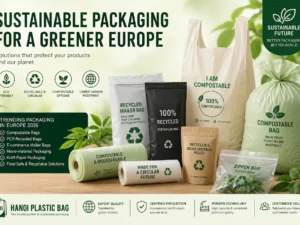
Biodegradable and Compostable Bags
As businesses increasingly explore sustainable packaging solutions, biodegradable and compostable bags have become important product categories.
These products are developed using specific material formulations, which may include PBAT, PLA, starch-based materials, or other certified compostable compounds.
Common applications include:
- Shopping bags.
- Garbage bags.
- Food waste bags.
- Produce bags.
- Pet waste bags.
Buyers should distinguish between biodegradable and compostable claims. They should request relevant test reports and certifications, such as EN 13432 or ASTM D6400 where applicable, and confirm that the certification covers the actual product and its intended composting conditions.
3. Plastic Materials Used in Bag Manufacturing
Material selection has a direct impact on the strength, flexibility, appearance, performance, and cost of plastic bags.
The most suitable material depends on the intended application and customer specifications.
High-Density Polyethylene (HDPE)
HDPE is commonly used for lightweight bags that require good stiffness and practical carrying performance.
Typical applications include shopping bags, T-shirt bags, produce bags, and certain garbage bags.
Low-Density Polyethylene (LDPE)
LDPE offers greater flexibility and a softer feel.
It is frequently selected for retail packaging, garment bags, flat bags, and products requiring a smooth surface.
Linear Low-Density Polyethylene (LLDPE)
LLDPE is valued for its flexibility, toughness, and puncture resistance.
It can be blended with other polyethylene materials to improve the mechanical properties of certain plastic bag products.
Recycled Polyethylene
Recycled polyethylene can be incorporated into suitable packaging products to reduce reliance on virgin plastic materials.
The percentage of recycled content, material source, product performance, and applicable regulations should be evaluated before selecting this option.
Compostable Material Blends
Compostable plastic bags may use formulations containing PBAT, PLA, starch, and other biodegradable or compostable components.
The performance and environmental claims of these products depend on their formulation, applicable standards, and independent testing.
A professional manufacturer should be able to discuss material options and help buyers identify the most appropriate specification for their applications.
4. Plastic Bag Manufacturing Process
Understanding the manufacturing process helps international buyers evaluate a supplier’s production capabilities and quality management.
A typical plastic bag manufacturing process includes several key stages.
Step 1: Raw Material Selection
The process begins with selecting the appropriate plastic resin or material blend.
Manufacturers consider the required thickness, flexibility, tensile strength, transparency, color, and intended application.
Step 2: Film Blowing and Extrusion
Plastic resin is processed through a film extrusion machine to produce continuous plastic film.
During blown film extrusion, molten plastic passes through a circular die and is inflated into a bubble before being cooled and flattened into film.
The film thickness and width are adjusted according to the product specifications.
Step 3: Printing
Plastic films can be printed with company logos, product information, brand artwork, and customized designs.
Flexographic printing is commonly used for flexible plastic packaging because it supports continuous production and multiple printing colors.
Artwork preparation, color matching, and print registration are important considerations when producing customized bags.
Step 4: Cutting and Sealing
The printed or unprinted plastic film is converted into finished bags through cutting and heat-sealing operations.
Different bag styles require different cutting patterns, handle configurations, and sealing methods.
Step 5: Quality Inspection
Finished products are inspected according to agreed specifications.
Common quality checks include:
- Bag dimensions and thickness.
- Sealing strength.
- Tensile and load-bearing performance.
- Printing quality and color consistency.
- Appearance and contamination.
- Packing quantity and labeling.
Step 6: Packaging and Export
After inspection, products are packed according to customer requirements.
Manufacturers prepare cartons, shipping marks, packing lists, and other relevant export documents for international shipments.
5. Custom Plastic Bag Manufacturing and OEM Solutions
For international brands, distributors, and retailers, customized manufacturing is often more important than purchasing standard plastic bags.
A professional OEM plastic bag manufacturer should be able to develop products based on customer drawings, samples, specifications, and brand requirements.
Customized Sizes and Thicknesses
Buyers can specify bag dimensions, gusset sizes, film thickness, and other technical requirements.
Thickness is commonly measured in microns (μm) or mils, depending on the target market and purchasing specifications.
Custom Printing and Branding
Printed plastic bags help businesses increase brand visibility and create consistent packaging across their retail and distribution networks.
Customization options may include:
- Company logos.
- Brand colors.
- Product information.
- Promotional artwork.
- Barcode and product identification.
Printing capabilities should be confirmed with the manufacturer based on artwork complexity and production requirements.
Private Label Manufacturing
Private-label manufacturing allows retailers and distributors to sell plastic bag products under their own brands.
The manufacturer produces the goods according to agreed specifications, while the buyer controls the brand identity and commercial distribution.
Flexible Order Specifications
Different buyers have different purchasing requirements.
An experienced manufacturer should discuss minimum order quantities (MOQ), sample development, production lead times, and packaging specifications before confirming an order.
6. Quality Control and International Compliance
Quality consistency is one of the most important considerations when sourcing plastic bags from Vietnam.
International buyers should evaluate not only the finished product but also the manufacturer’s quality management system.
Important considerations include:
ISO 9001: A quality management system standard that helps organizations establish consistent processes and improve operational performance.
BSCI: A supply-chain social compliance audit framework that evaluates working conditions and responsible business practices.
Food Contact Compliance: Plastic bags intended for food contact may need to comply with applicable regulations in the destination market, including relevant FDA requirements in the United States or EU food-contact legislation.
Compostability Certifications: Compostable products may require independent certification and testing under standards such as EN 13432 or ASTM D6400, depending on the intended market and claim.
Buyers should always request current certificates, test reports, and supporting documentation. Certification of a material or one product should not automatically be assumed to cover every product manufactured by the same company.
7. How to Choose Reliable Plastic Bag Manufacturers in Vietnam
Selecting the right supplier is essential for protecting product quality, controlling costs, and ensuring reliable deliveries.
Before placing a bulk order, international buyers should evaluate the following factors.
Manufacturing Experience
Look for manufacturers with a proven history of producing the specific types of plastic bags you need.
Relevant experience can indicate that a supplier understands production requirements, material selection, and common quality challenges.
Factory and Production Capacity
Evaluate the manufacturer’s actual production facilities, machinery, workforce, and ability to handle your expected order volume.
If possible, arrange a factory visit or request a virtual factory tour.
Product Quality and Consistency
Request samples before confirming mass production.
Compare samples against the agreed specifications, including thickness, dimensions, printing, sealing, and overall performance.
Customization Capabilities
If you require branded packaging, check whether the manufacturer offers in-house printing, custom bag production, artwork support, and private-label services.
Export Experience
An export-experienced supplier should understand international packaging requirements, shipping documentation, and communication with overseas customers.
Ask about previous export markets and the manufacturer’s experience with your destination country.
Communication and Customer Support
Clear communication is essential when discussing technical specifications, order changes, samples, and delivery schedules.
A responsive supplier can help reduce misunderstandings and improve the overall procurement process.
8. Plastic Bag Manufacturers in Vietnam for Different Industries
Plastic bags are used across a wide range of industries.
Vietnamese manufacturers supply packaging products for different commercial and industrial applications.
Retail and Supermarkets
T-shirt bags, shopping bags, produce bags, and carrier bags are commonly used by supermarkets, grocery stores, and retail chains.
Food and Beverage
Food packaging bags and produce bags are used for packaging, storage, and distribution. Material selection and food-contact compliance must be considered according to the intended application.
Fashion and Garment
Flat poly bags, LDPE bags, and other protective packaging formats are used by clothing manufacturers, fashion retailers, and e-commerce businesses.
E-commerce and Logistics
Mailing bags and lightweight packaging products help businesses protect and distribute products through online retail and logistics networks.
Household and Waste Management
Garbage bags, drawstring bags, and bags on rolls are widely used for household, commercial, and industrial waste collection.
9. Sourcing Plastic Bags from Vietnam: What Buyers Should Prepare
To receive an accurate quotation from a manufacturer, buyers should provide as much product information as possible.
A clear inquiry helps manufacturers evaluate material requirements, production processes, pricing, and delivery schedules.
Consider preparing the following information:
- Product type: HDPE, LDPE, T-shirt bags, flat bags, drawstring bags, or garbage bags.
- Bag dimensions: Width, length, and gusset size.
- Material: HDPE, LDPE, LLDPE, recycled PE, or compostable materials.
- Thickness: Required thickness in microns or mils.
- Printing: Number of colors, artwork, and printing requirements.
- Quantity: Estimated order volume and purchasing frequency.
- Packaging: Inner packing, carton quantity, labeling, and shipping marks.
- Destination: Country, port of destination, and preferred shipping terms.
Buyers should also clarify sample requirements, production lead times, payment terms, and applicable inspection procedures before confirming a purchase order.
10. Hanoi Plastic Bag – Your Plastic Bag Manufacturing Partner in Vietnam
Hanoi Plastic Bag is a Vietnamese plastic bag manufacturer specializing in HDPE and LDPE packaging products for domestic and international markets.
With manufacturing operations in Hung Yen Province, Vietnam, the company focuses on producing a range of plastic bag solutions for retail, supermarkets, food packaging, household use, and commercial applications.
The company’s manufacturing portfolio includes six main product groups:
- T-shirt bags and carrier bags.
- Flat plastic bags.
- Drawstring bags.
- Plastic bags on rolls.
- Soft loop handle bags.
- Biodegradable and compostable bags.
According to its published company profile, Hanoi Plastic Bag has developed export relationships with customers in more than 50 countries worldwide.
The company focuses on supporting international buyers with product customization, manufacturing solutions, and export-oriented services.
Manufacturing and Product Capabilities
Hanoi Plastic Bag provides plastic packaging solutions based on different material specifications, product dimensions, thicknesses, colors, and printing requirements.
Its product range serves various applications, including:
- Supermarkets and retail chains.
- Grocery stores and food businesses.
- Wholesalers and packaging distributors.
- Industrial and commercial packaging.
- Household and waste management.
Custom Manufacturing for Global Buyers
The company works with customers looking for customized plastic bag products that meet their commercial and packaging requirements.
Buyers can discuss product specifications, material selection, printing artwork, order quantities, and packaging arrangements with the manufacturing team.
International Supply
Hanoi Plastic Bag aims to build long-term relationships with international importers, distributors, wholesalers, and retail businesses.
By combining manufacturing experience with export-oriented customer support, the company seeks to provide practical packaging solutions for global markets.
If you are looking for a plastic bag manufacturer in Vietnam, Hanoi Plastic Bag welcomes inquiries from businesses interested in bulk purchasing, OEM manufacturing, and customized packaging solutions.
11. Frequently Asked Questions About Plastic Bag Manufacturers in Vietnam
1. Why should I source plastic bags from Vietnam?
Vietnam offers competitive manufacturing costs, an established plastic processing industry, and manufacturers with experience supplying international markets. Buyers can source different types of plastic bags and request customized production based on their requirements.
2. What types of plastic bags are manufactured in Vietnam?
Common products include HDPE shopping bags, LDPE bags, T-shirt bags, flat bags, drawstring bags, garbage bags, plastic bags on rolls, and biodegradable or compostable bags.
3. Can Vietnamese manufacturers produce custom printed plastic bags?
Yes. Many manufacturers offer customized sizes, thicknesses, colors, printing designs, and packaging formats. Specific printing capabilities and minimum order quantities should be confirmed with each supplier.
4. What is the minimum order quantity (MOQ) for custom plastic bags?
MOQ varies depending on the bag type, material, dimensions, printing requirements, and production process. Buyers should contact the manufacturer with their specifications to obtain an accurate quotation.
5. Do plastic bag manufacturers in Vietnam export internationally?
Yes. Many Vietnamese manufacturers serve international markets, including North America, Europe, Australia, Asia, and other regions. Export experience and destination-specific compliance should be verified with the individual supplier.
6. What materials are commonly used for plastic bags?
The most common materials include HDPE, LDPE, and LLDPE. Manufacturers may also offer recycled polyethylene and specialized compostable material blends depending on product requirements.
7. Can I order biodegradable or compostable plastic bags from Vietnam?
Yes. Some Vietnamese manufacturers produce biodegradable and compostable bags using specialized material formulations. Buyers should request relevant certifications and independent test reports to verify the environmental claims.
8. How can I verify a plastic bag manufacturer in Vietnam?
You can request the company’s business information, factory address, production photographs or videos, product samples, quality certifications, and relevant export documentation. A factory audit or third-party inspection can provide additional assurance.
9. How long does plastic bag production take?
Production lead times depend on product specifications, order quantity, raw material availability, printing requirements, and factory scheduling. Custom orders may also require additional time for sampling and artwork approval.
10. How can I get a quotation from Hanoi Plastic Bag?
Contact Hanoi Plastic Bag with your product type, dimensions, material, thickness, printing requirements, estimated order quantity, and destination country. The sales team can review your requirements and provide further information about suitable manufacturing options.
Top Plastic Bag Manufacturers in Vietnam
When sourcing packaging solutions from Vietnam, partnering with an established, export-experienced manufacturer is critical to ensuring product quality, regulatory compliance, and reliable supply chain logistics. Below are some of the most reputable plastic bag manufacturers and groups in Vietnam:
1. Hanoi Plastic Bag JSC
Location: Hanoi & Hung Yen Province
Overview: One of the pioneer and leading joint-stock manufacturing companies in Northern Vietnam. Operating large-scale facilities equipped with advanced machinery adhering to ISO 9001:2015 and Japanese Industrial Standards (JIS), Haplast exports significant volumes to Europe, the USA, Asia, and Africa.
Key Products: T-shirt shopping bags, garbage bags on roll, food storage bags, die-cut handle bags, and eco-friendly biodegradable packaging.
2. Haplast
Overview: Alongside major joint-stock corporations, a network of specialized flexible packaging plants located in industrial hubs across Vinh Phuc, Bac Ninh, Hung Yen, and Binh Duong cater to custom OEM/ODM bulk orders. These factories focus heavily on high-speed blowing lines, multi-color flexographic printing, and strict compliance with global standards such as BSCI, ISO 14001, and BRCGS.
Looking for a Plastic Bag Manufacturer in Vietnam?
Finding a reliable manufacturing partner is an important step toward building a competitive and sustainable packaging supply chain.
Whether you are sourcing HDPE shopping bags, LDPE packaging bags, T-shirt bags, garbage bags, or customized compostable products, choosing a manufacturer with relevant production capabilities and export experience can make a significant difference to your business.
Contact Hanoi Plastic Bag today to discuss your requirements and explore customized plastic bag manufacturing solutions in Vietnam.
Request a Quote / Contact Us
Ready to source high-quality plastic packaging from Vietnam?
Email: info@hanoiplasticbag.com
Hotline/WhatsApp: +84
Website: hanoiplasticbag.com/en